Meet Wanjiku: an accountant in Nairobi with a salary of Ksh 185,000, a small side business, a car loan, what's left of her HELB loan, a SACCO, a money-market fund and a plot in Kitengela. Here is what SmartPFM shows her – and what it changed.
Wanjiku is a demo account with sample figures, built to show the app with realistic Kenyan numbers. Every screen below is the real app.
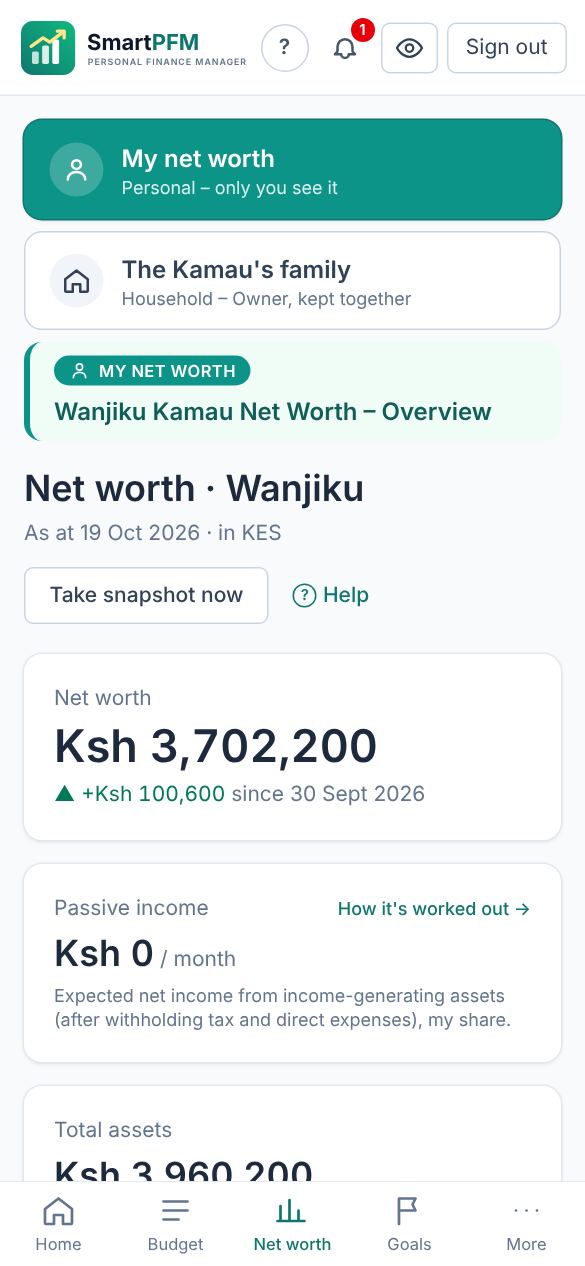
1 · Net-worth growth
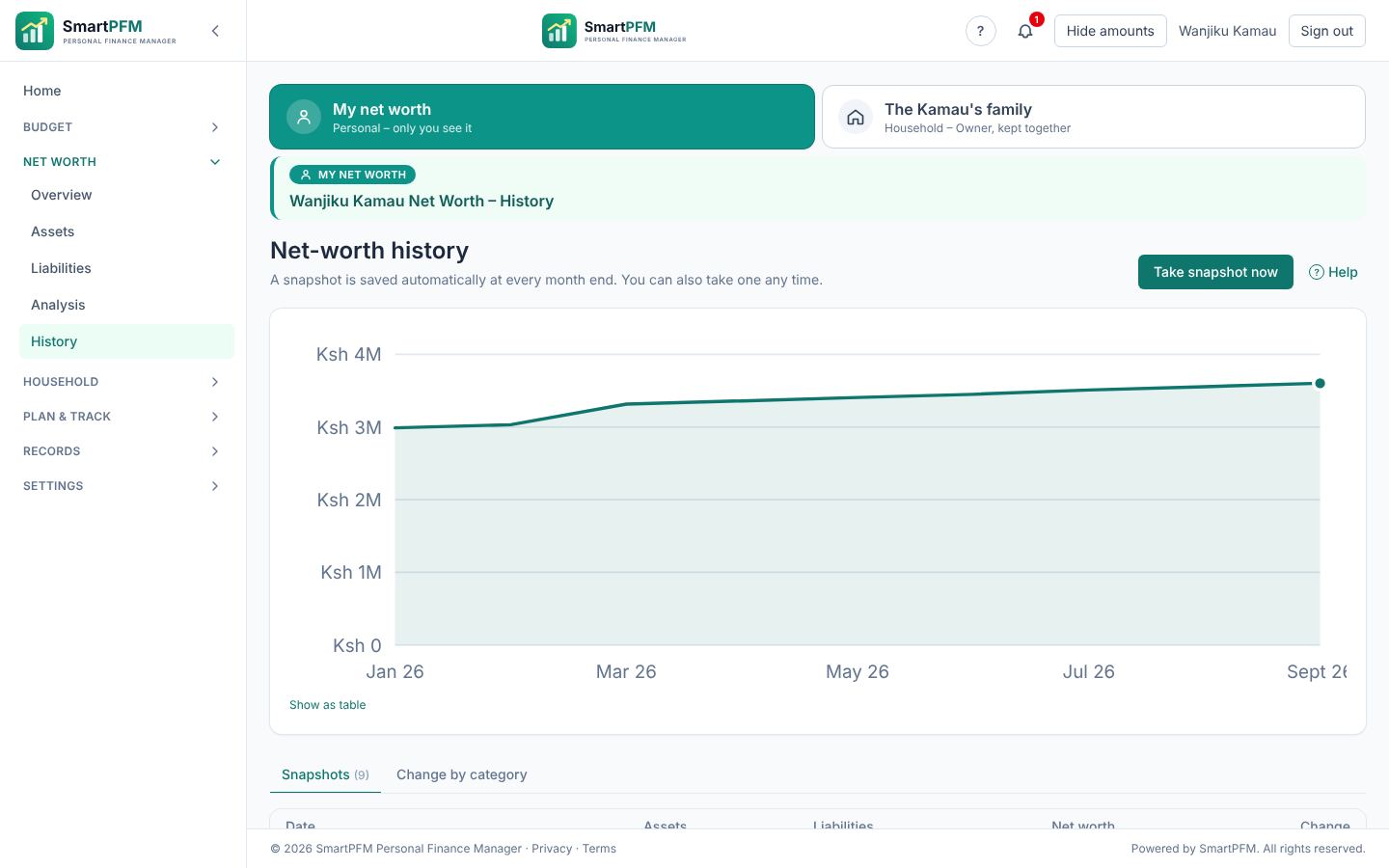
From Ksh 2.9 million to Ksh 4.3 million
Ksh 4,331,537net worth today
+Ksh 1,029,935over the last 12 months
+Ksh 102,500since last month-end
Before SmartPFM, Wanjiku "felt" she was doing fine but couldn't say by how much. Now a snapshot is taken at every month-end. The line rises almost every month because her budget pays down debt and adds to savings; a dip, like July's, is easy to explain, and the land revaluation in March 2026 shows as the step it was.
The value: she can see the effect of every decision on one number, and so can stop guessing.
Net worth over time, with the alerts panel clear.History: every month-end, with the change.
2 · Clearing debt
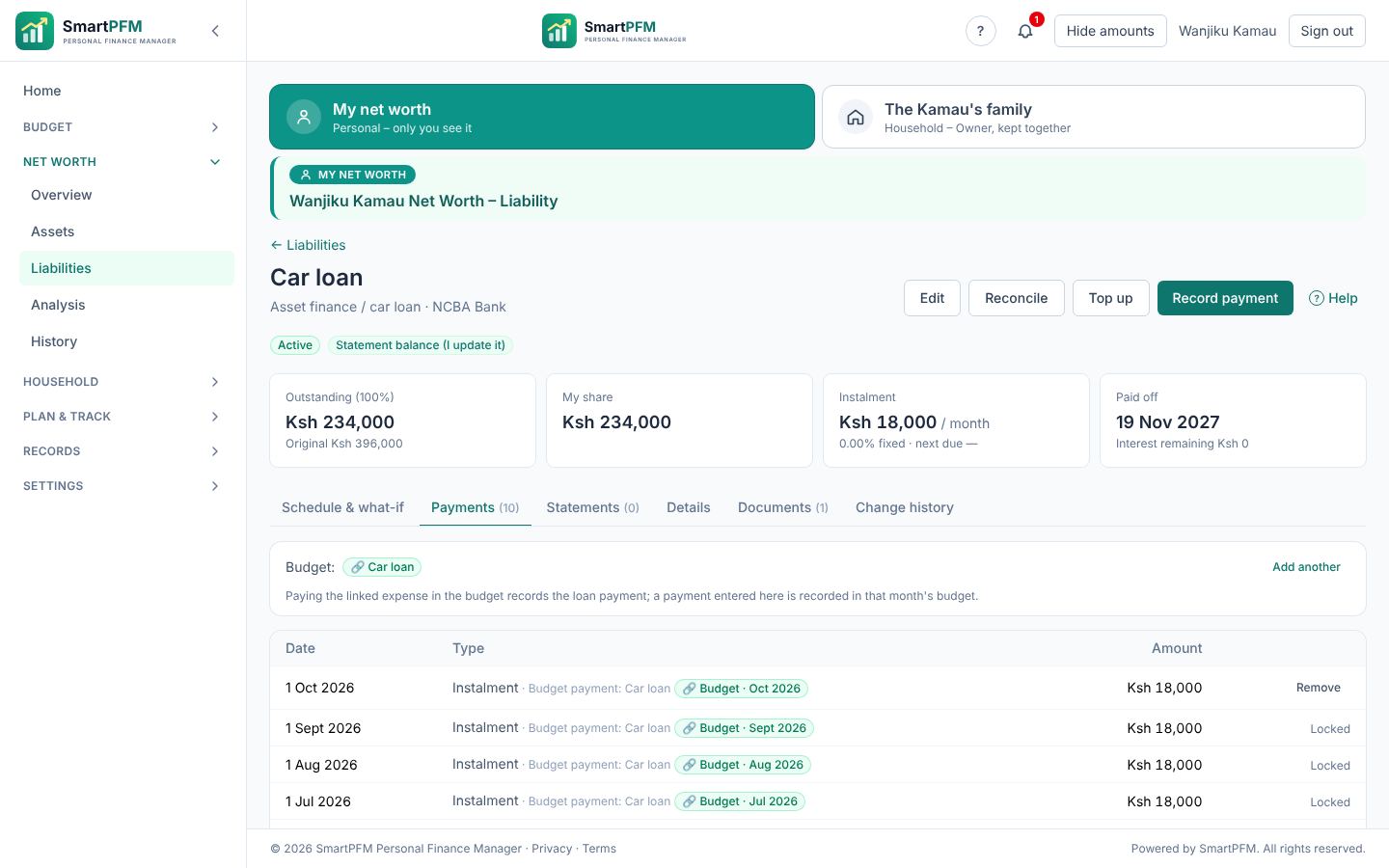
The car loan, halved without a single double entry
Ksh 900,000borrowed
Ksh 425,000left today
Mar 2028paid off
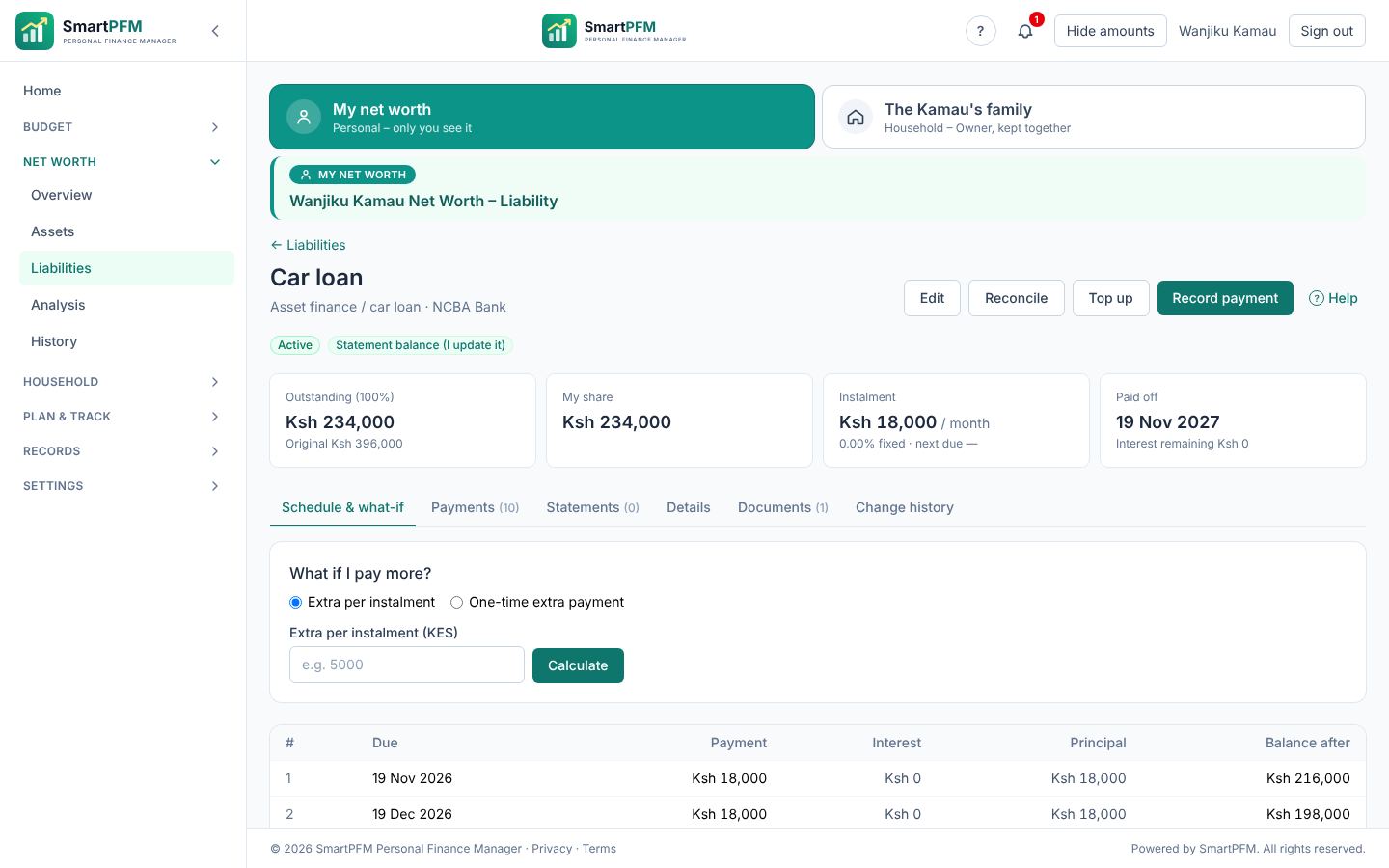
The Car loan expense in her budget is linked to the loan. The NCBA standing order goes out on the 1st, Auto-Spend records it, and the instalment appears on the loan – tagged with the budget month that paid it. Debt-to-asset ratio: 9.9 %.
The value: one record, two places updated, and the what-if shows that an extra Ksh 10,000 a month would clear it months earlier.
3 · Saving that compounds
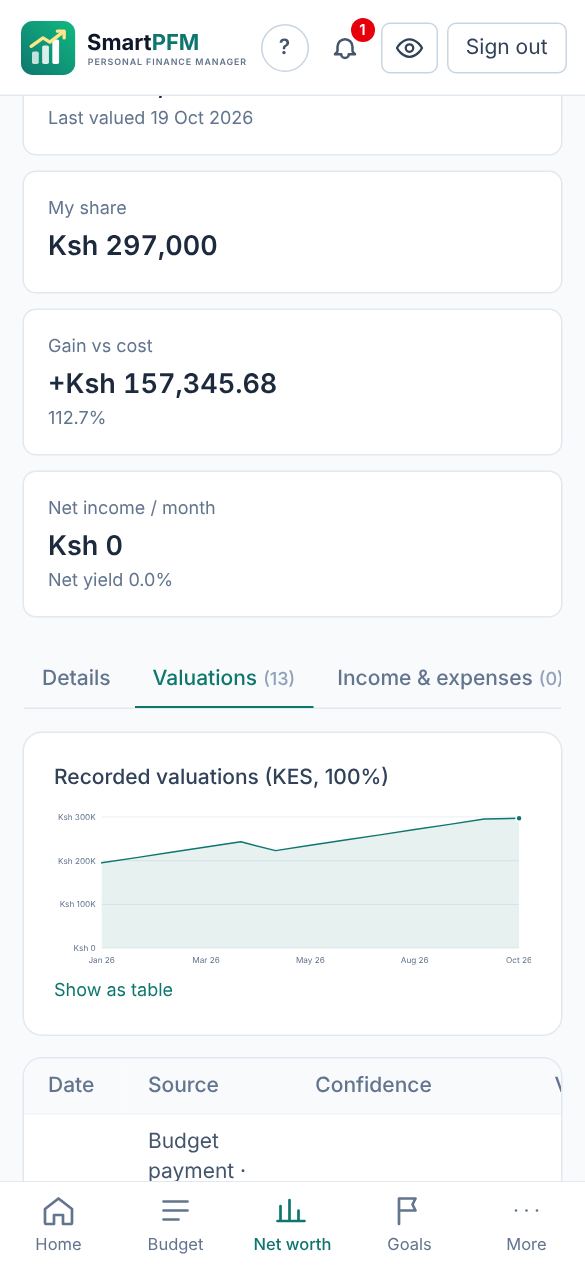
A SACCO that grew from Ksh 180,000 to Ksh 526,578
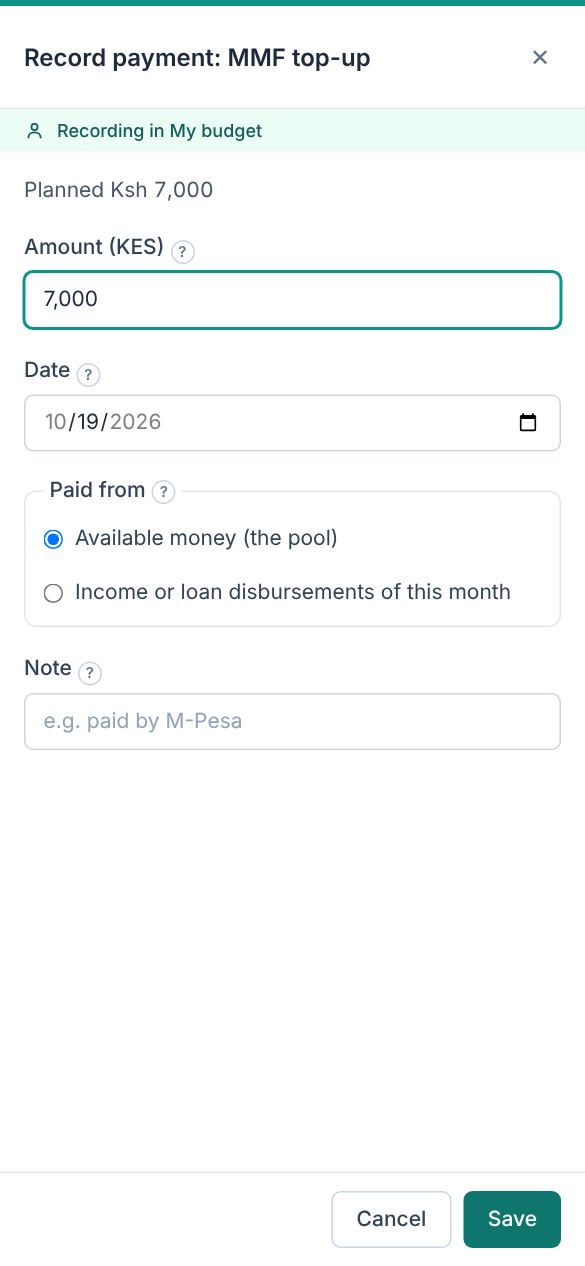
Ksh 15,000 goes to the SACCO every month, from the salary, through a budget item linked to the asset. Each April the dividend is added as a valuation. Her MMF top-ups work the same way.
Because SACCO deposits usually set how much you can borrow, she always knows her loan limit – and her deposits are counted as investable, not as cash she might spend.
The value: saving stops being "whatever is left at month-end" and becomes a planned line that she can watch grow.
4 · A budget that closes in the black
Three months closed – each one with a bigger surplus
Ksh 36,480July closing
Ksh 82,820August
Ksh 124,860September, carried into October
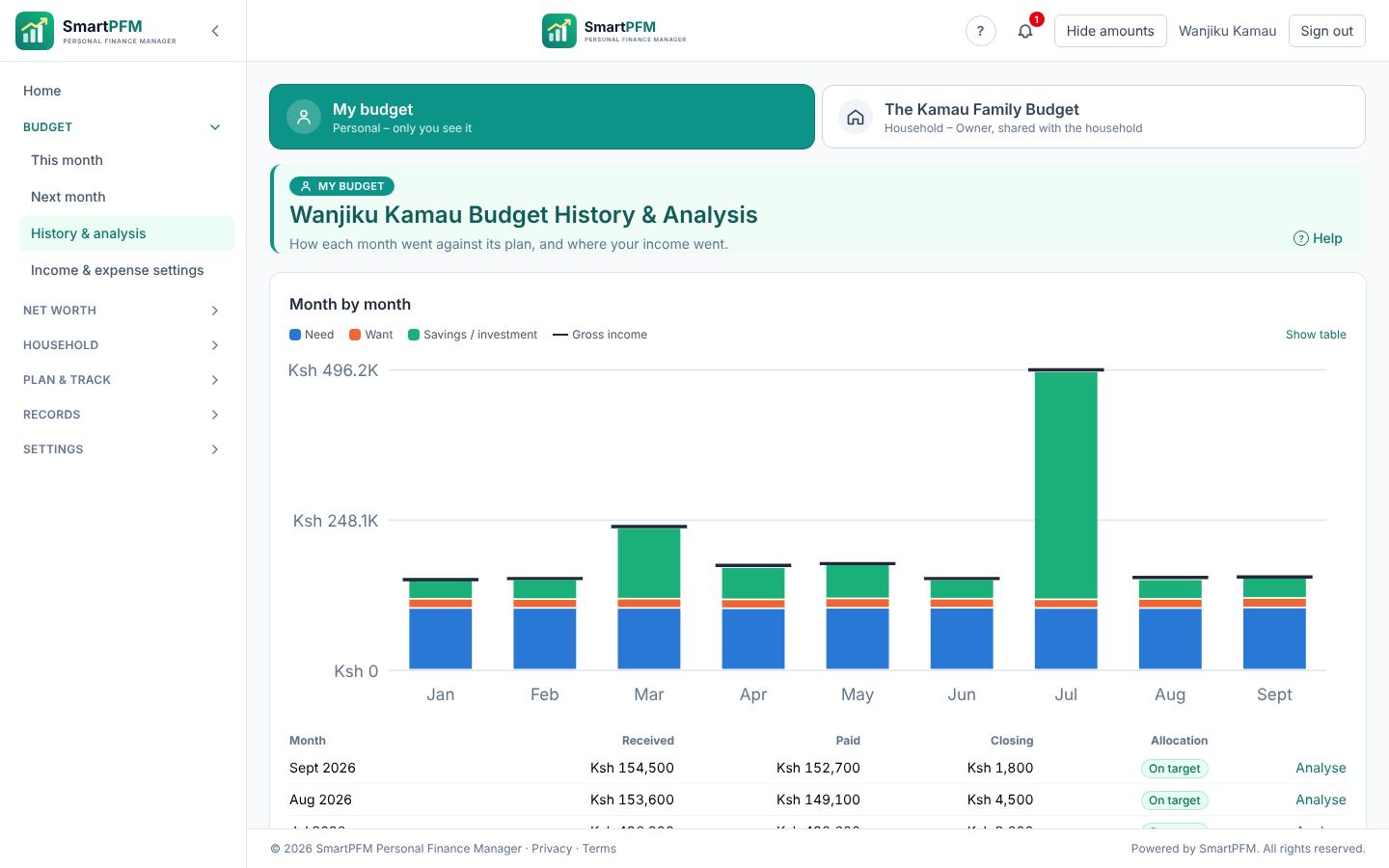
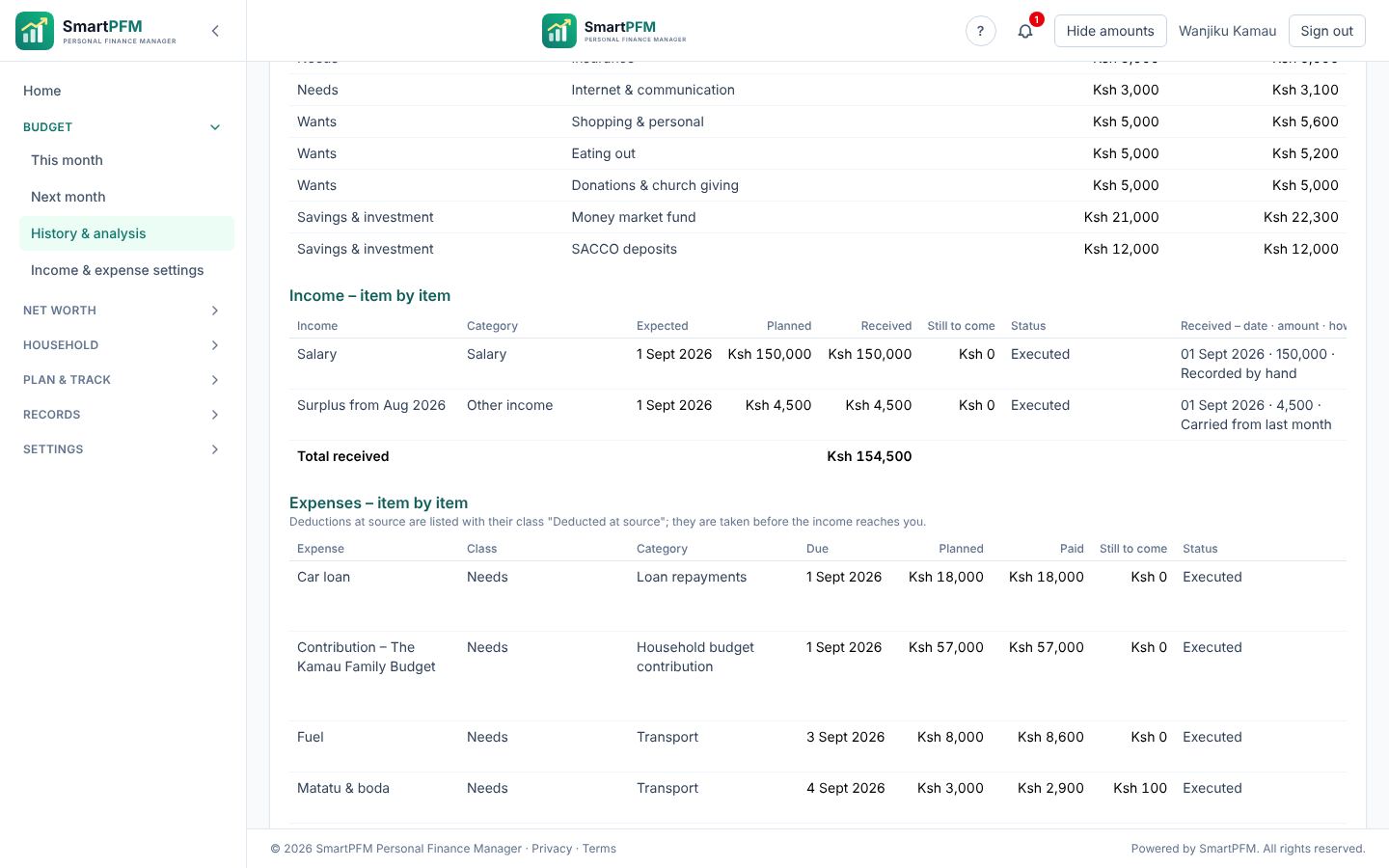
Every month is planned from her settings, recorded as money moves and closed on the 3rd. The surplus carries forward as income for the next month. History & analysis shows needs, wants and savings against her income – and flags that her split is still off target, so there's something to work on.
The value: a clear monthly rhythm – plan, do, review, improve – and a detailed statement for every month.
The monthly statement – on screen, PDF or Excel.
5 · No more surprises
School fees, KPLC and DSTV – planned, paid and never forgotten
Each expense is set up once, with how it's paid in its notes – the KPLC paybill and account number, the school's bank account. When the day comes, she opens the item on her phone and the details are right there. School fees that aren't paid by month-end are deferred to next month instead of vanishing.
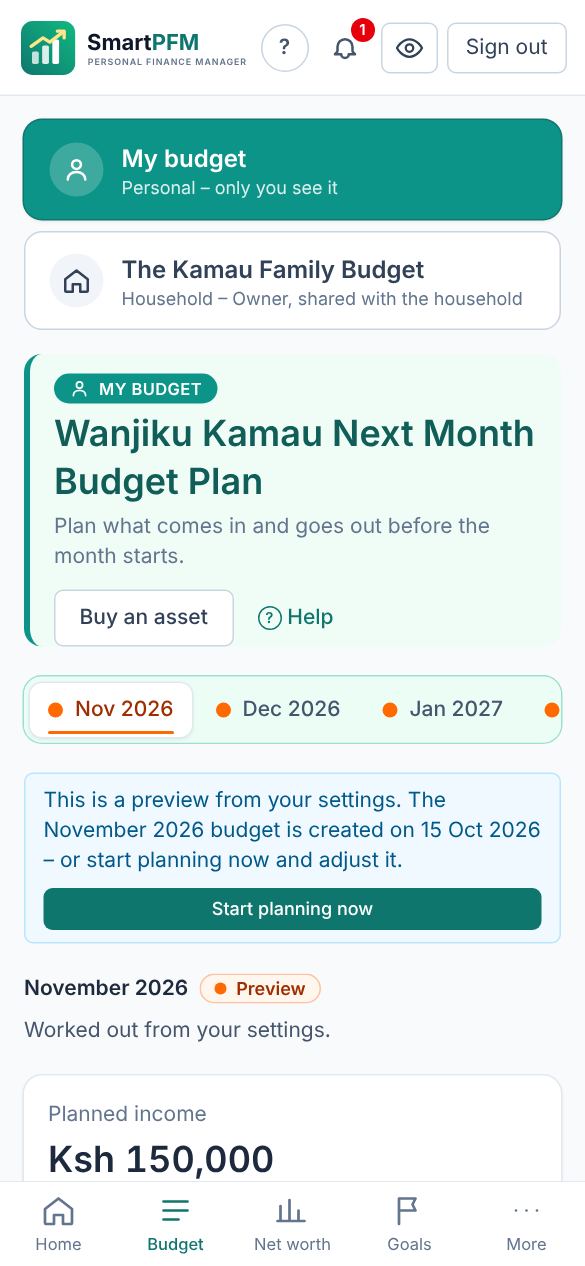
Next month is ready on the 15th and shows the planned balance before the month starts: Ksh 38,500 to spare in November.
The value: nothing slips, and the phone does the remembering.
6 · Peace of mind
The Kitengela title deed – safe, and attached to the land
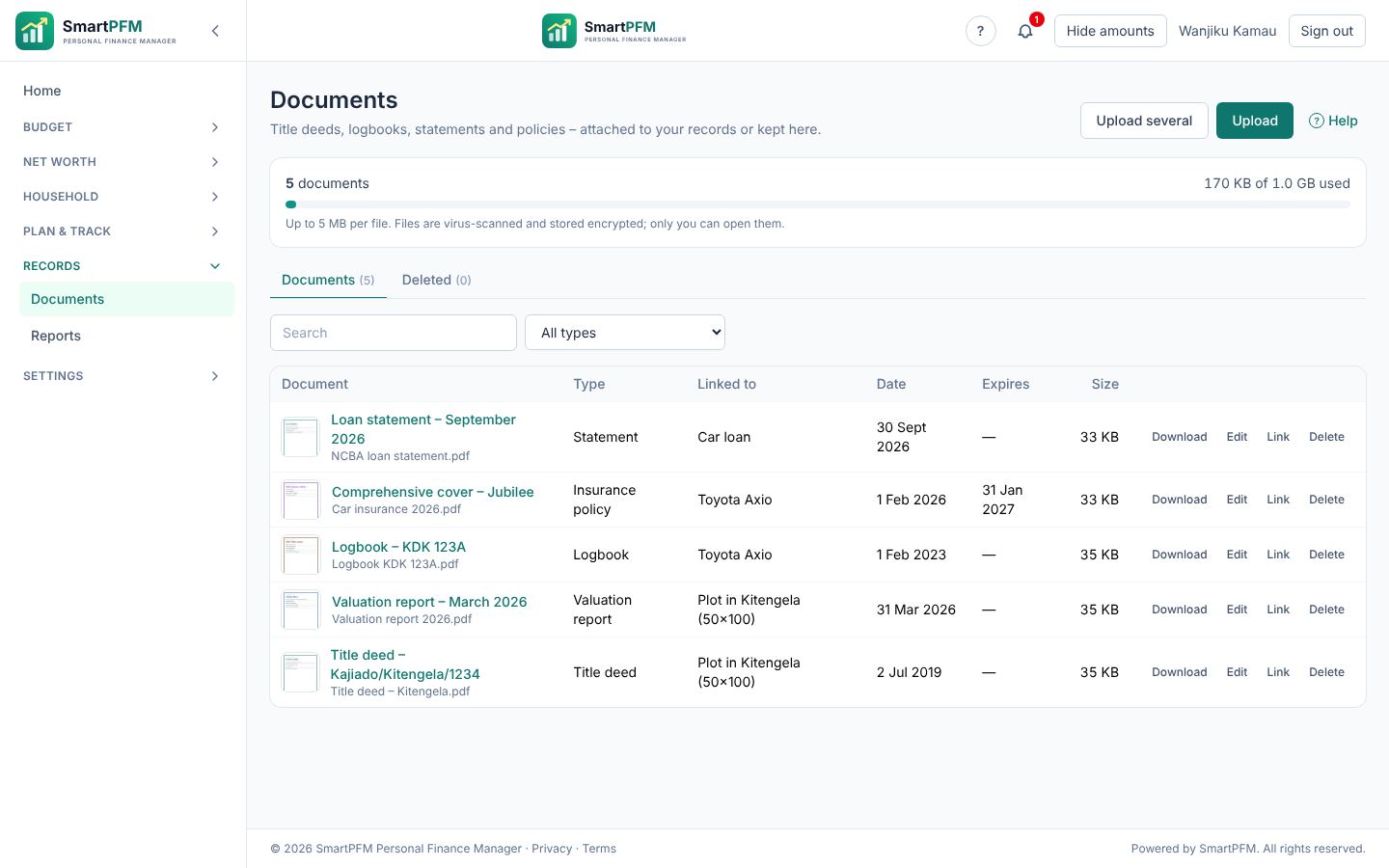
The plot was valued at Ksh 2.4 million, and at Ksh 2.8 million after the March 2026 valuation report. The title deed and the valuation report sit with the land; the logbook and the insurance policy with the car; the loan statement with the loan – each file encrypted with its own key. The policy's expiry date sends her a reminder 30 days before renewal.
The value: when the bank asks for documents, they're two taps away – and they're not sitting in an email inbox.
7 · Somewhere to aim
Goals that keep score by themselves
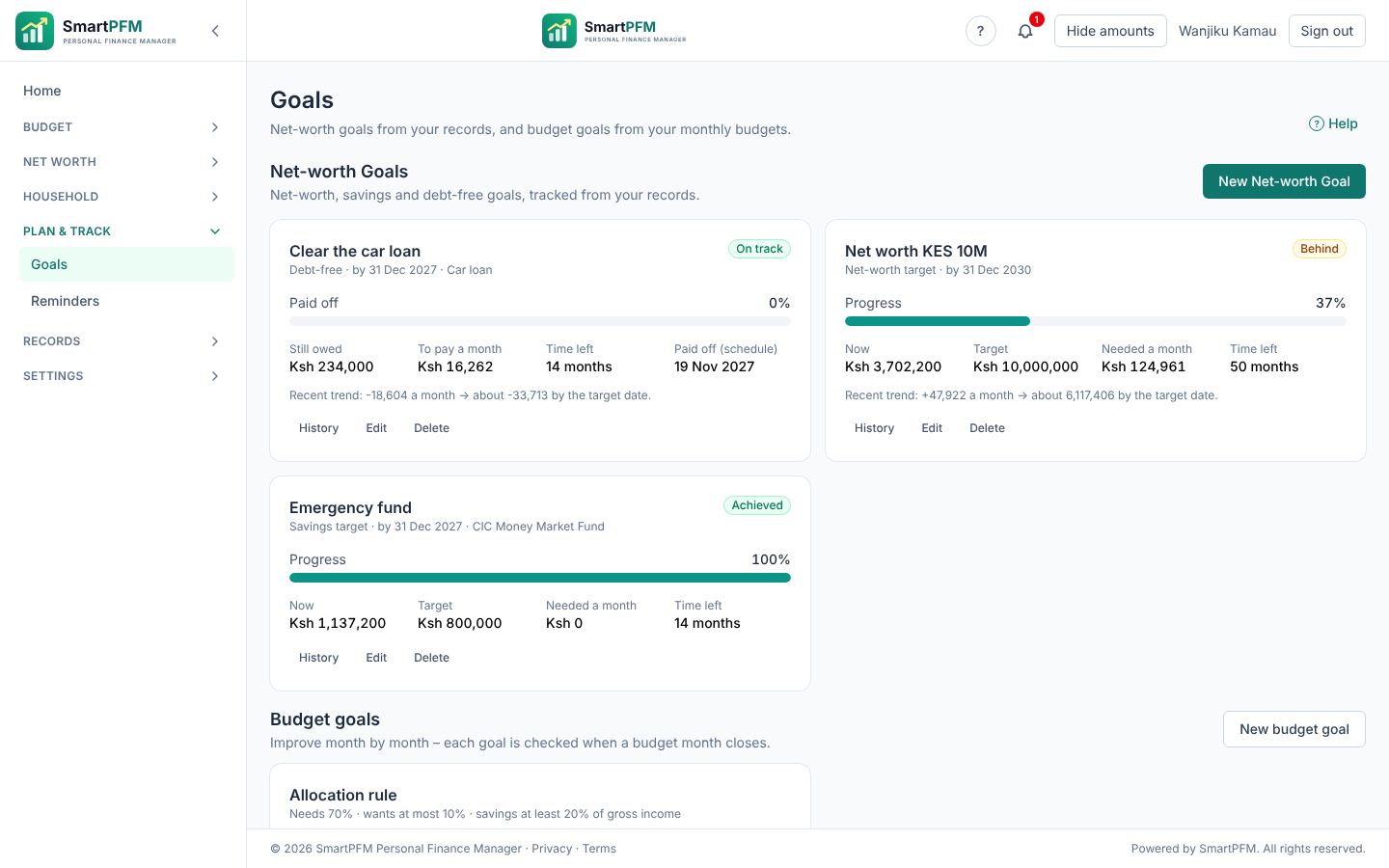
An emergency fund of Ksh 800,000 in her MMF (32 % there), clearing the car loan, and a net worth of Ksh 10 million (43 % there). Progress is recorded every month-end from her real figures – no manual updating.
The value: big goals become a percentage that moves every month.
8 · The family picture
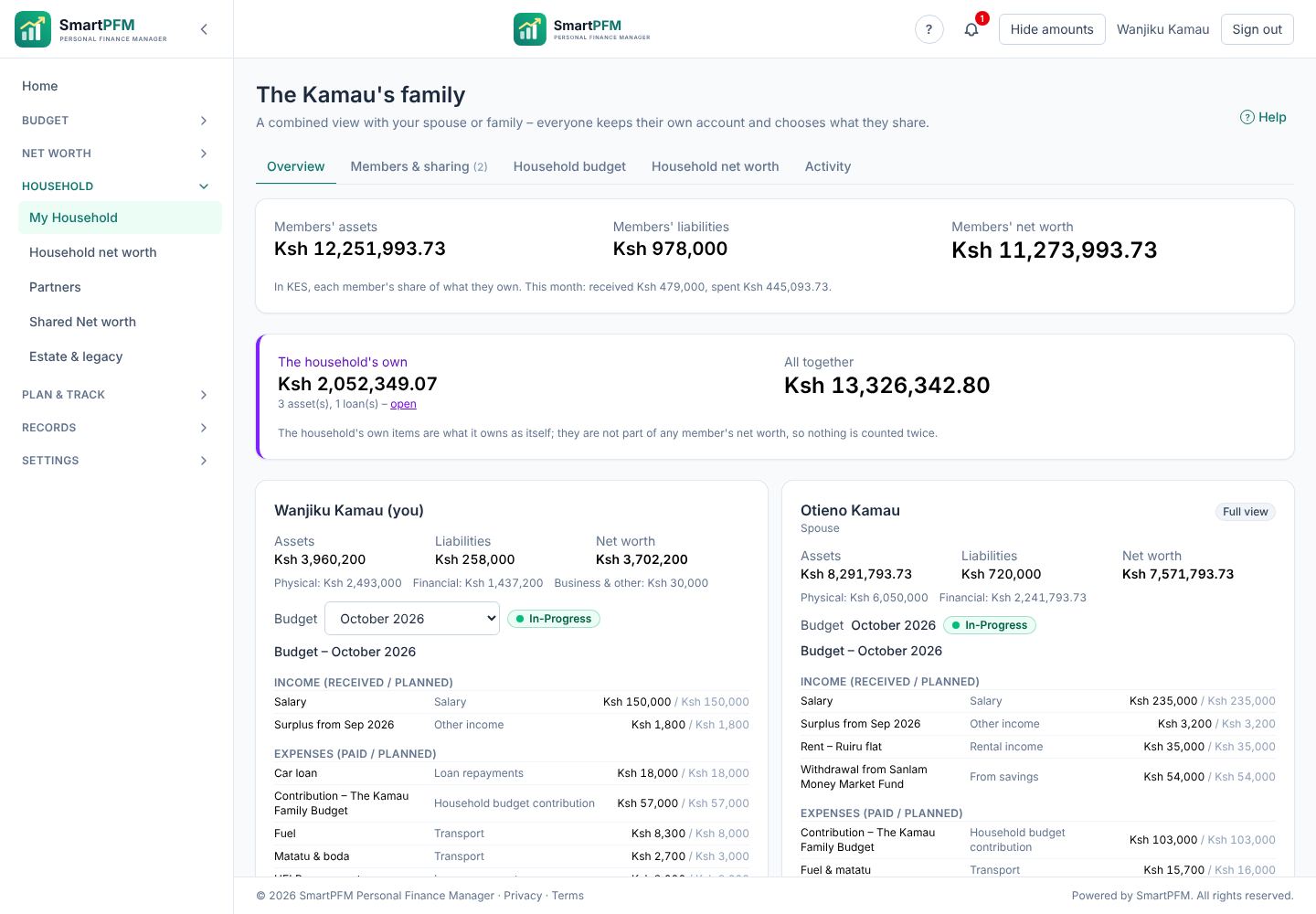
Two accounts, one household: Ksh 13.3 million together
Wanjiku's husband Otieno keeps his own SmartPFM account: a rental flat in Ruiru with its mortgage and his Mwalimu SACCO. They formed The Kamau family household and both share a full view. Each keeps their own net worth – Ksh 3.7 million and Ksh 7.6 million, counting only their own share of the Kitengela plot they own together – and the household owns a family fund, the Noah and its loan as itself (Ksh 2.1 million). The household page shows all three, and what each of them is spending this month.
The value: they plan as a family without merging accounts, nothing is counted twice, and what is shared is their choice.
8b · The family budget
One pot for the bills they share – and no arguments about who paid
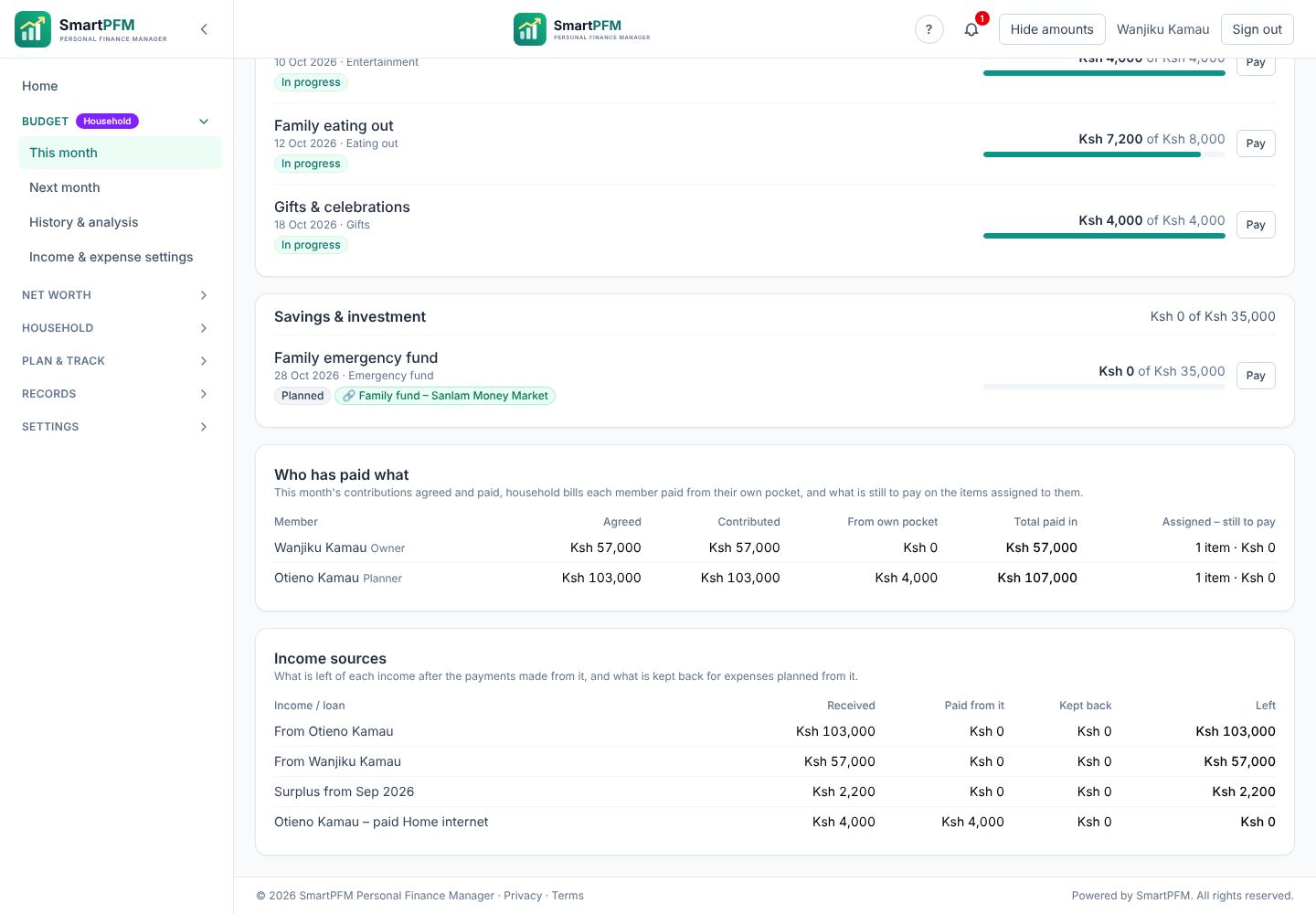
Rent, food, school fees, the househelp, power and internet now live in The Kamau Family Budget. Wanjiku puts in Ksh 70,000 and Otieno Ksh 80,000 on the 1st – both to the joint Equity account, as their contribution notes say – each recorded once, in their own budget and the family's. Otieno pays the rent; the school fees are assigned to Wanjiku, so their reminders go to her; when Otieno paid the internet with his own money, it counted as his.
The value: a shared plan, each person's own budget still private, and Who has paid what answers the question before it is asked.
9 · Nothing left to guess
The will, the nominations and the title deed – on one page
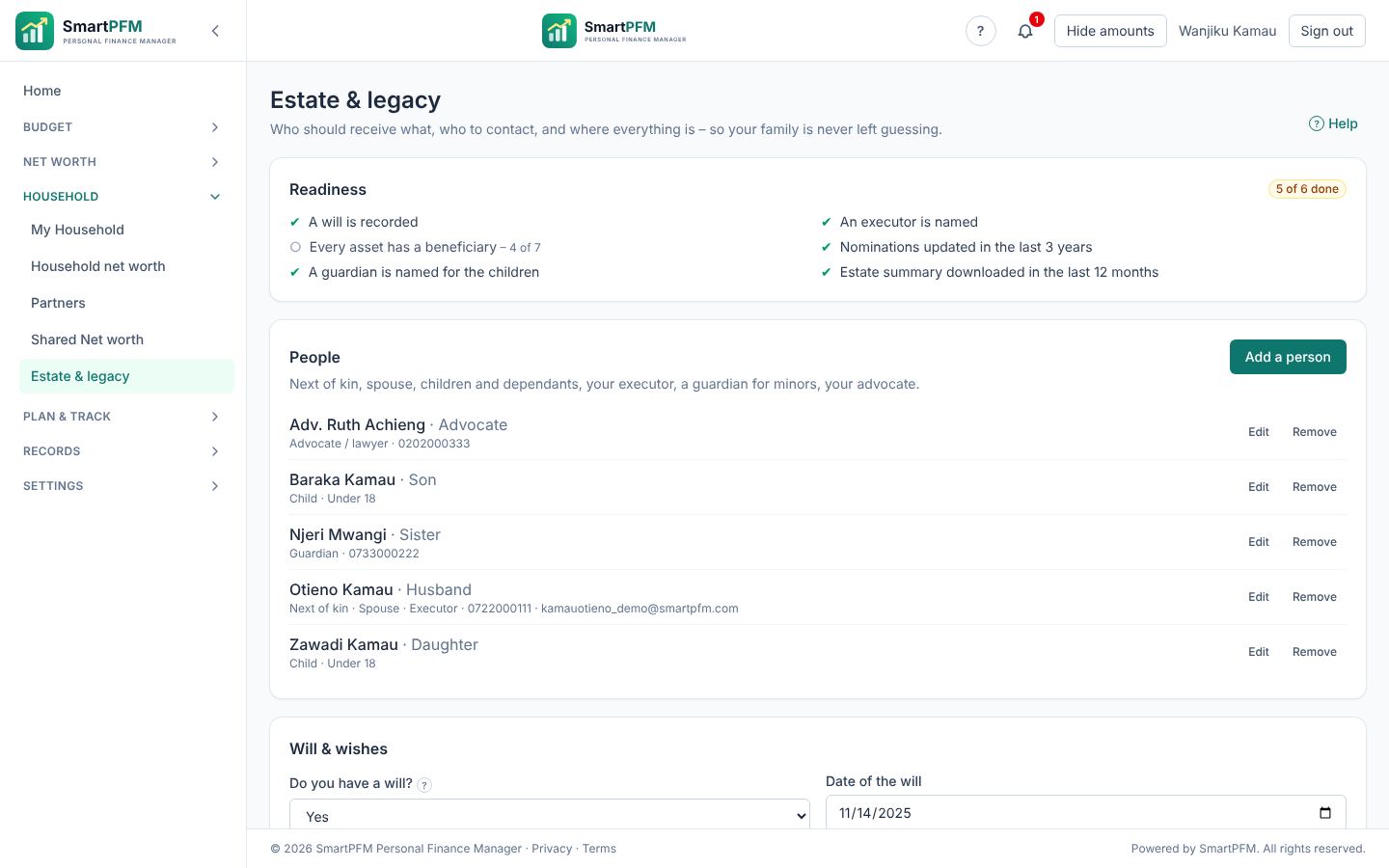
Wanjiku's estate plan names Otieno as executor and next of kin, her sister as guardian for Zawadi and Baraka, and her advocate, who holds the will. The plot goes to the children 50/50; the SACCO and the money-market fund are nominated to Otieno. The checklist shows 5 of 6 done – one asset still needs a beneficiary.
The value: if the worst happens, her family has an estate summary instead of a search.
Your own story starts with one screen
Add what you own and owe today, and next month you'll have your first point on the line.